A pool league, off the spreadsheets.
Flow Masters used to run its two formats, team Masters and individual One-Pocket, out of Excel workbooks, paper scoresheets and a Weekly Packet assembled by hand. This app replaced all of it with one live system: sessions, rosters, handicaps, pairings, scores, money and the packet, built around the league's own rules rather than a generic league template.
By the numbers
The app
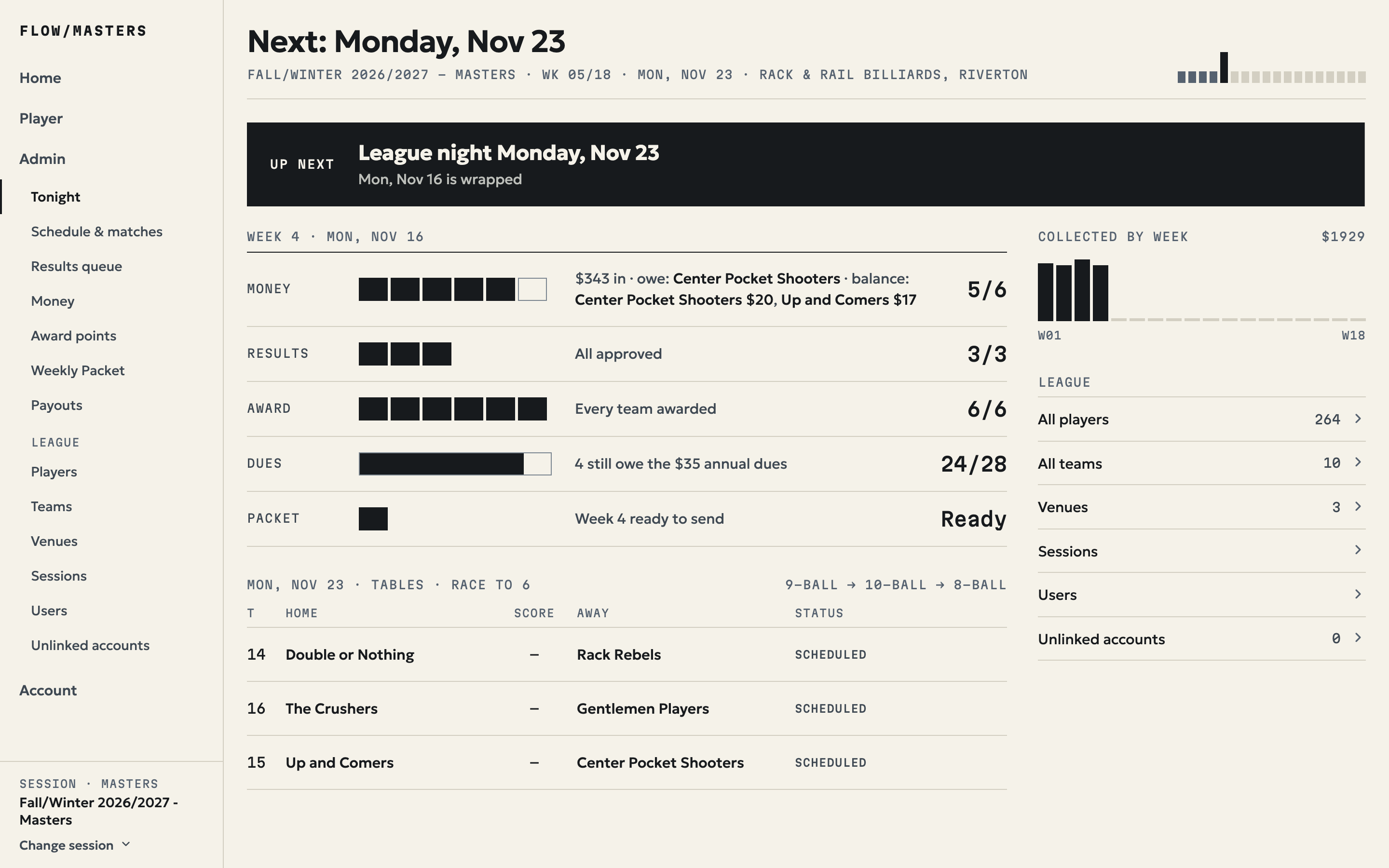
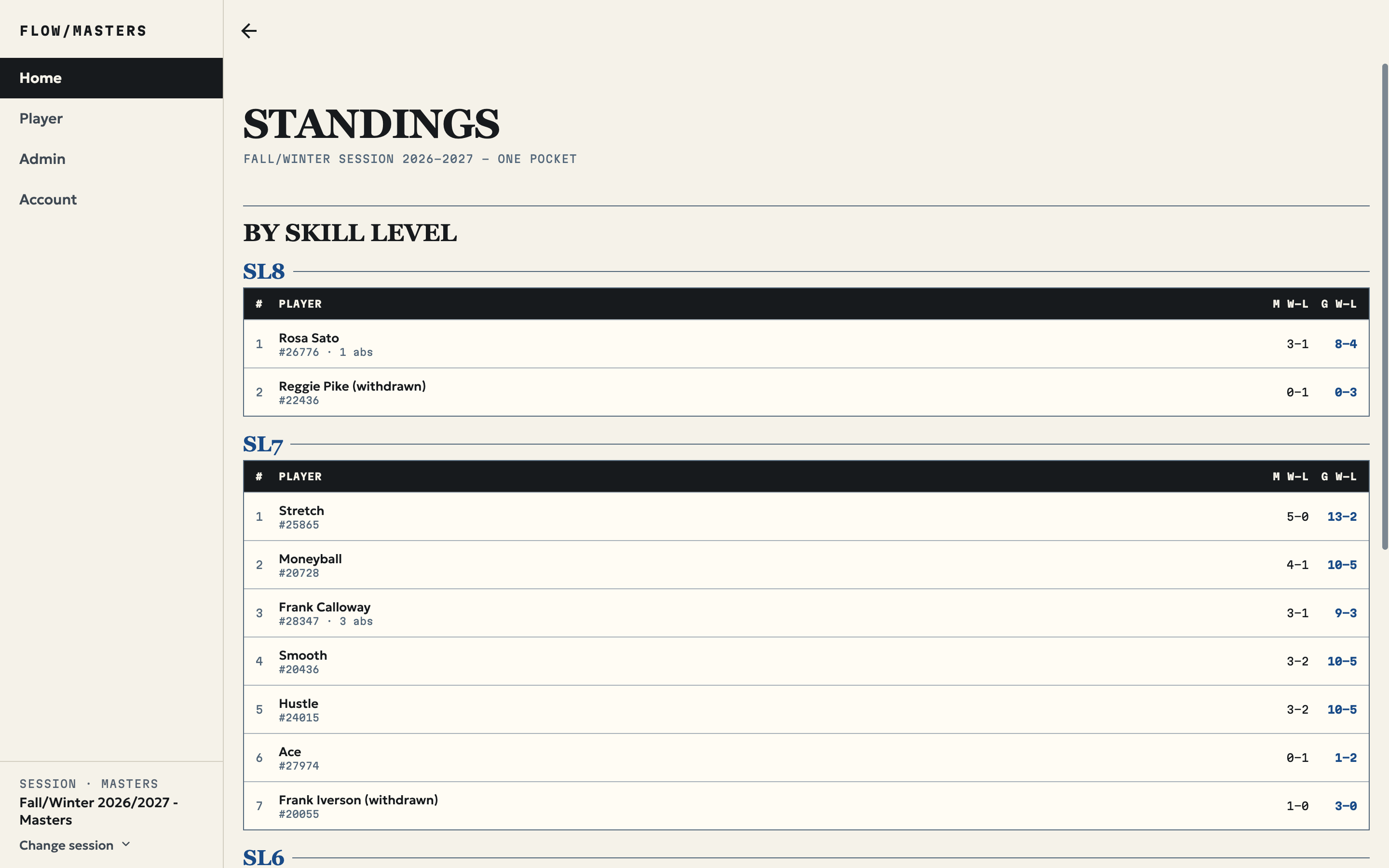
The operator works from a laptop or tablet at the hall on league nights; players use their phones. The Tonight dashboard answers "what's left before this week is done": who still owes, which results need review, whether award points are in and whether the packet is ready to send.
What it does
Two formats, modeled properly
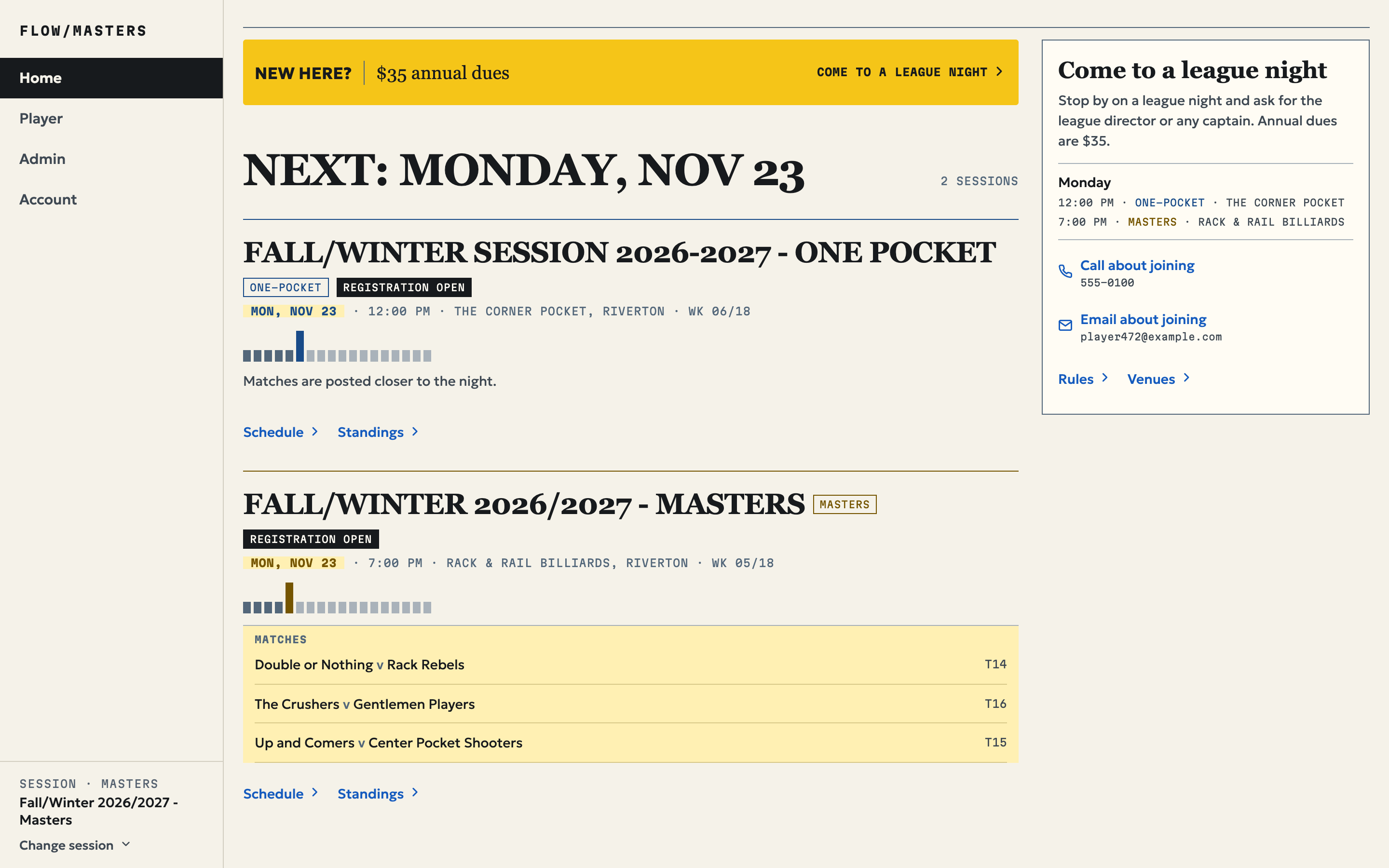
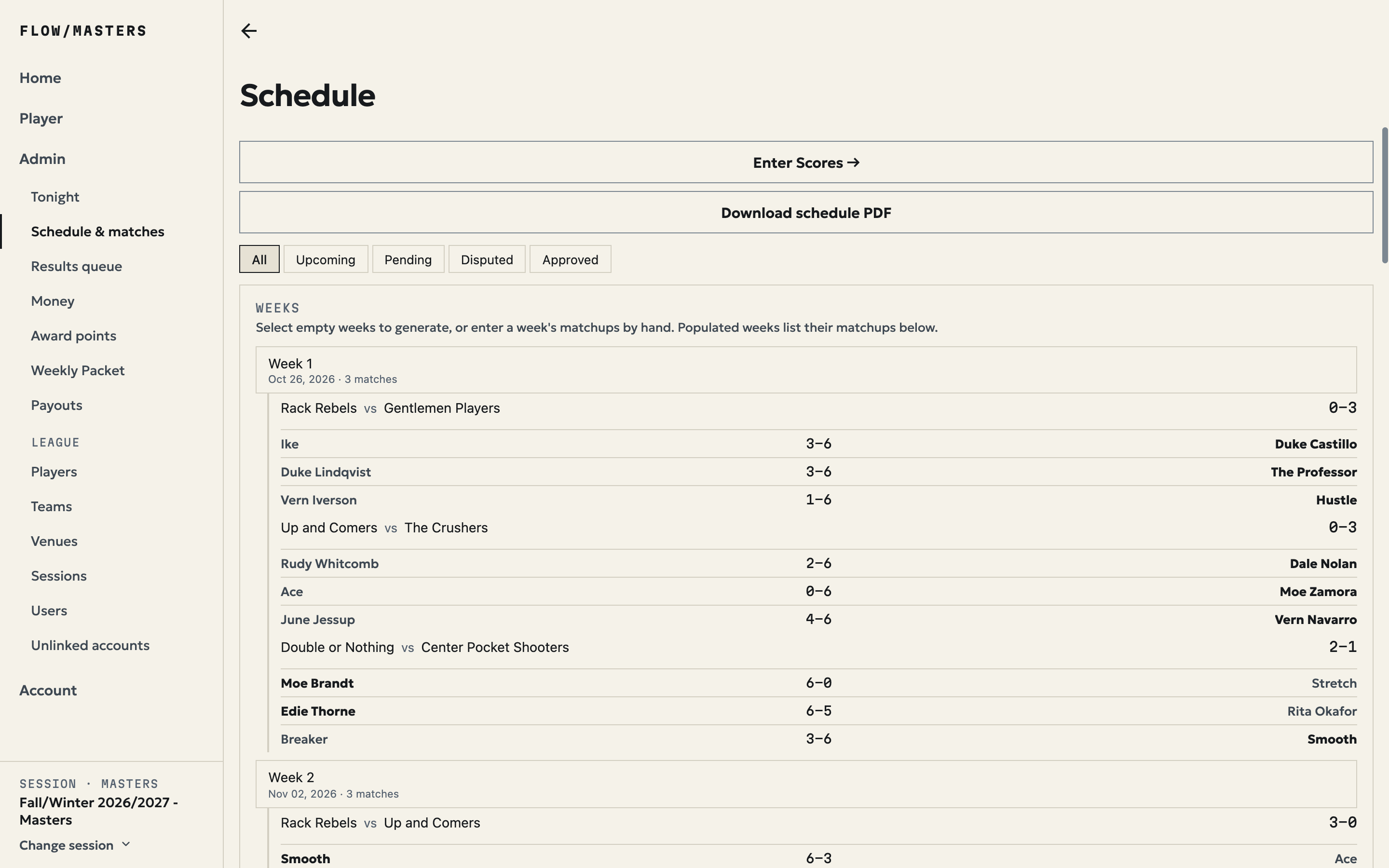
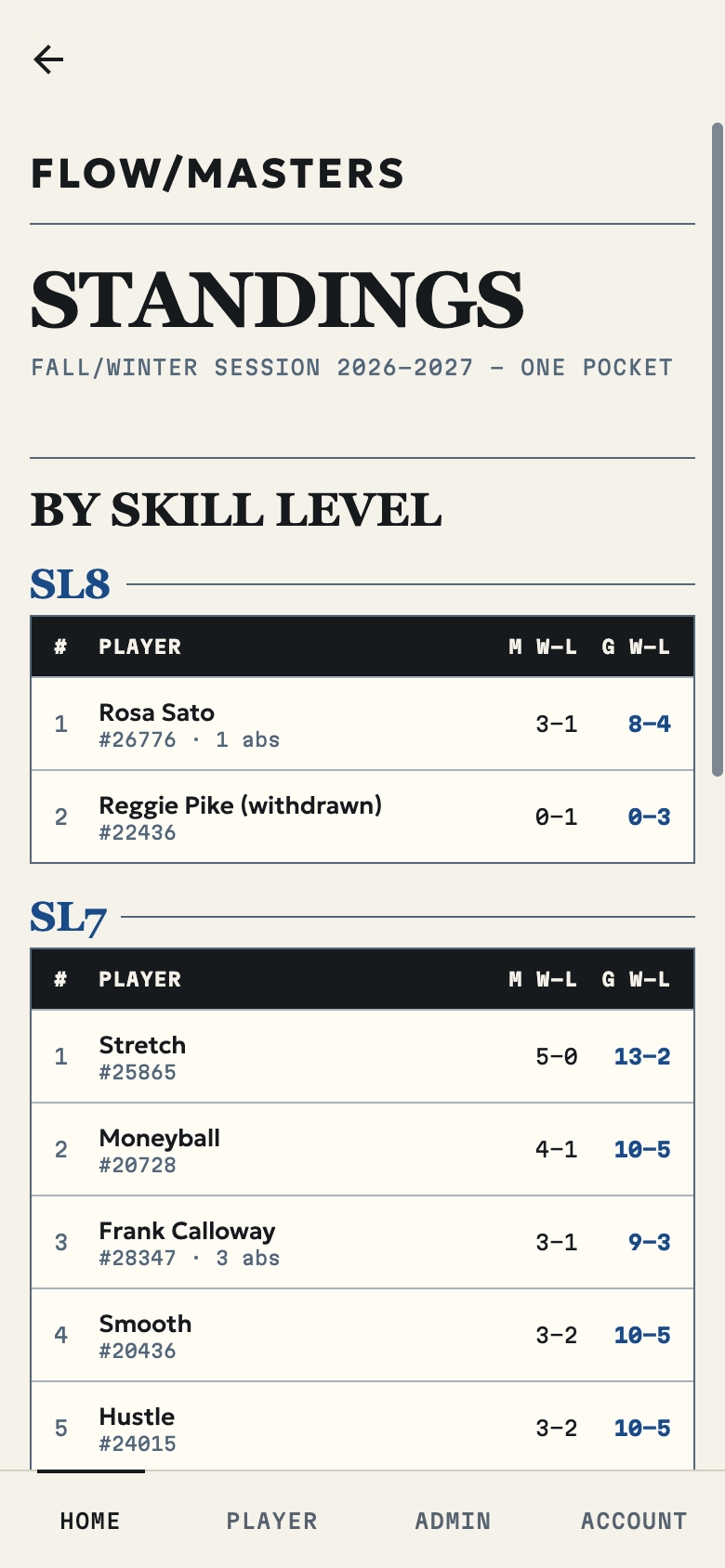
Masters is teams racing to 6 through a fixed 9-ball, 10-ball, 8-ball sequence. One-Pocket is individuals, best of 3, with handicapped short counts, standings per skill level and dynamic weekly pairing.
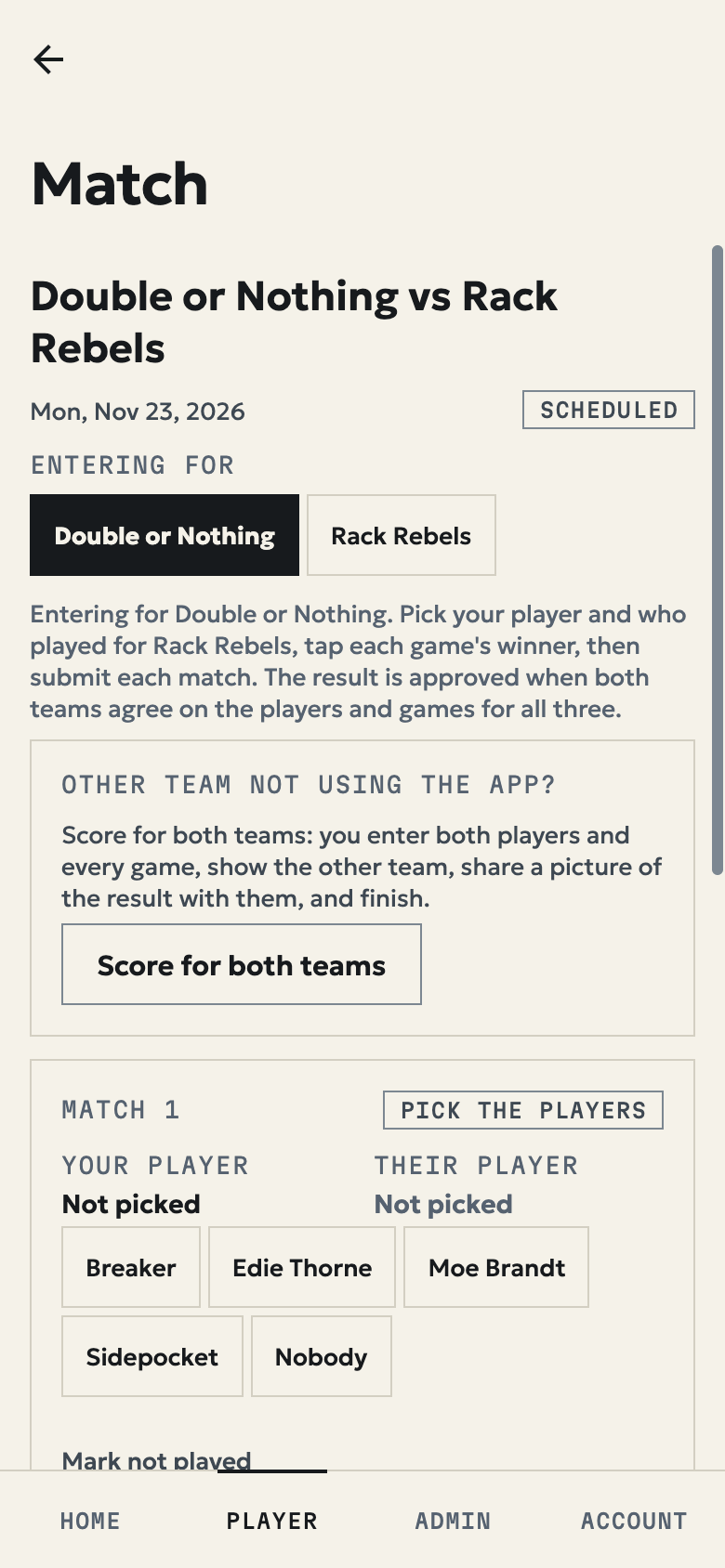
Score entry both teams agree on
Any linked roster member can enter a match. The result is approved when both sides agree on the players and every game; mismatches go to a review queue. If the other team isn't on the app, one side can score for both.
The league's own rules, encoded
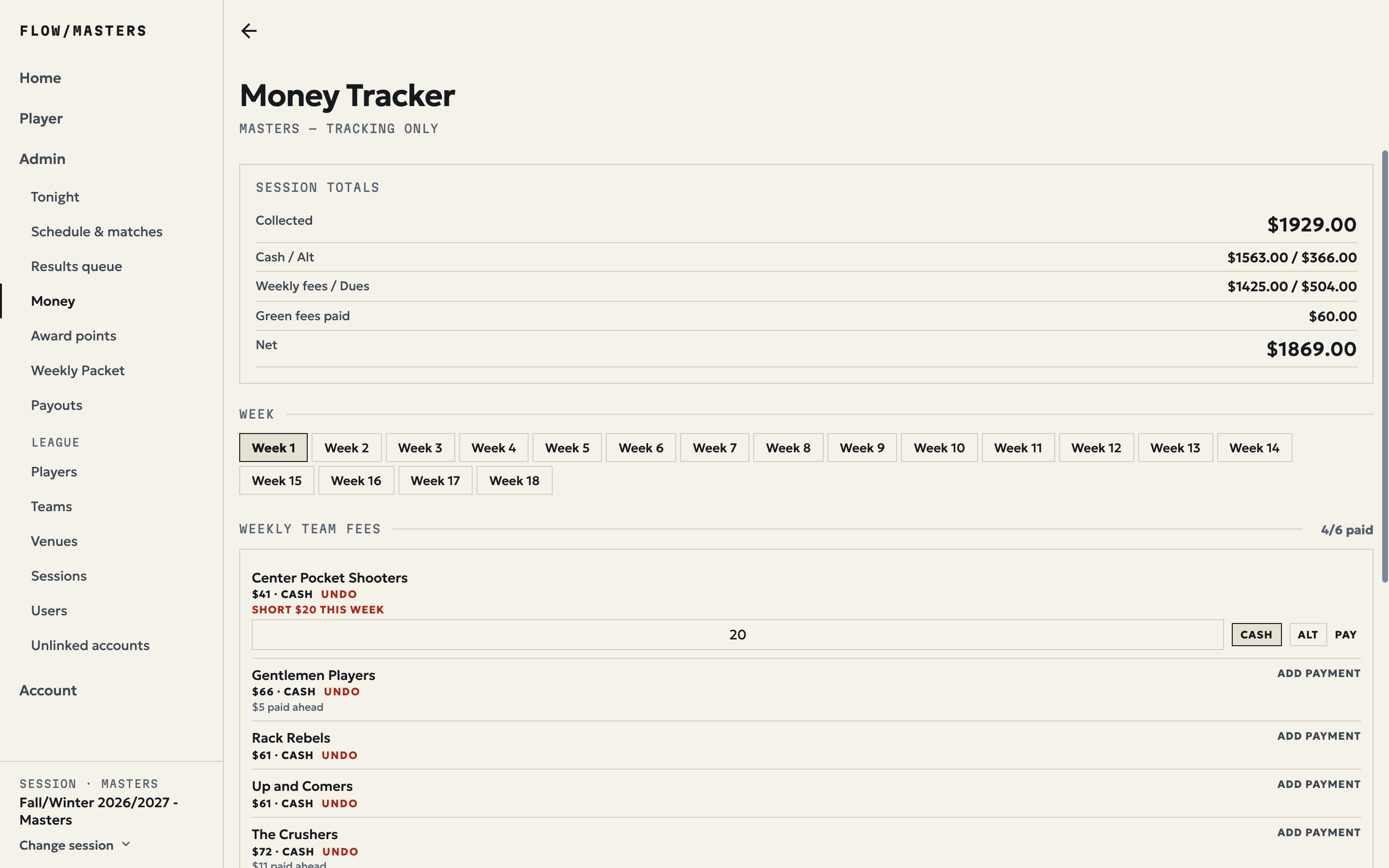
Absences and playoff eligibility, late joins, handicap reviews from the last five scored results, and money tracked the way the league does it: cash vs. alternate payment, green fees, dues and payouts.
The Weekly Packet
Standings, results, money and operator notes compiled into a point-in-time packet each week, exported as a PDF instead of assembled by hand.
Stack
One Expo codebase shipped to the web through React Native Web, with iOS and Android targets ready. Supabase holds the league: row-level security on every table, and score entry and approval rules enforced in Postgres functions so a client can't write a result it isn't allowed to. Because the app has to match spreadsheets rule for rule, risky migrations get a rehearsal script and an undo script before they touch production.
App
- Expo SDK 52
- React Native 0.76
- React Native Web
- React 18
- React Navigation 7
- react-native-svg
- Expo Print & Sharing
- Expo Image Picker
- Expo Mail Composer
- Geologica & Martian Mono
Data
- Supabase Postgres
- Supabase Auth
- Supabase Storage
- Row-Level Security
- PL/pgSQL functions
- Custom auth email templates
- Resend (transactional email)
Ops
- Vercel
- Vercel Analytics
- Sentry + source maps
- OpenTelemetry
- GitHub Actions
- Cloudflare R2 (encrypted DB backups)
Process
- Node test runner
- Linear
- Custom Claude Code agents
Notes
- Screenshots are from the real app with every person, venue, contact detail and player ID replaced by placeholders, and money figures scaled. Team names and league formats are real.
- I build it with a team of custom Claude Code agents, each defined with its own role, brief and limits: a product manager that keeps the Linear backlog, a designer, an engineer, a tester, a code reviewer, and an art critic that can block generic design. I set the priorities, scope and re-scope the work, choose between approaches, review every change and approve what ships. The agents do the legwork between those decisions.
- Error reports are scrubbed of personal data before they reach Sentry, and a nightly GitHub Actions job dumps the database, encrypts it with age before it leaves the runner, and stores it in Cloudflare R2: nightly copies kept 90 days, monthly copies kept 3 years.